

Restaurants
Your tables full.
Your phone quiet.
One assistant answers every guest in seconds — from your Instagram page, from an ad, from the QR code on the table — books them in, and writes it straight into the system you already use. Your team never leaves the floor.
- More covers. The guest who asks at 23:40 books with you instead of calling the restaurant next door.
- An hour a day back. 25 guest calls and messages at three minutes each — handled without your team.
- Fewer empty tables. Changing or cancelling takes one message, so the slot goes back on sale instead of standing empty.
- Guests who come back. An answer in four seconds, in their own language, at any hour — that is the service they remember.
One table of four is € 220. The assistant costs € 500 once and € 50 a month.
What actually goes wrong
Not the booking itself — that part works. It is everything around it that lands on people who are carrying plates.
The phone rings during service
The busiest two hours of the evening are also when guests call. Someone leaves the floor, or nobody picks up and that guest calls the restaurant next door.“Do you have something for four tonight around eight?”
Nobody is there after closing
People plan dinner late at night and on the day the restaurant is shut. A widget takes the booking of someone who already decided; it answers no one who is still choosing.“Are you open on Monday?”
Changes and no-shows
Guests rarely cancel through the widget — they call, or they simply do not turn up. An empty table on a Saturday is money that cannot be recovered.“We'll be two fewer, is that alright?”
The same twenty questions
Hours, menu, allergens, parking, children, dogs, wheelchairs. Every day, on every channel, answered by hand.“Is there a vegan main?”
We are not a reservation system. The restaurant keeps the one it has, with its tables, its rules and its data. We add the part it never had: someone who answers, on every channel, in every language, at every hour — and who then writes the result into that same system.
What your restaurant wins
Not features — six things that change on the floor and in the books, from the first evening the code is on the tables.
No guest goes unanswered
Nights, Mondays, the middle of service. The guest who would have given up and called the restaurant next door books with you instead.
Gain: the bookings you never knew you were losing
Your team stays on the floor
The phone stops pulling someone away from a table for a question about parking, allergens or opening hours.
Gain: service that is not interrupted twenty times a night
Fewer empty tables
Moving or cancelling takes one message with the booking code, so guests actually do it instead of not turning up — and the table goes back on sale.
Gain: no-shows become cancellations you can resell
Every guest in your CRM
Name, phone, party size, allergies, history — written the moment the booking is made, not typed over later.
Gain: a guest list you own, ready to market to
Three languages, no extra staff
Dutch, English and German today. The guest picks the language; the assistant follows, in your tone of voice.
Gain: tourists book as easily as regulars
Nothing new to learn
No new screen for the team, no migration, no downtime. The booking appears where they already look every morning.
Gain: a change your staff never has to be trained for
The arithmetic behind all six is the same: one table of four saved is € 220, the assistant costs € 6.50 a month to run. It does not need to work often to be worth it.
The guest never leaves the restaurant's world
A QR code on the table, the menu, a flyer or a business card opens a chat carrying the restaurant's name, colours and tone. No app, no account, no login — and no visible “our-platform.com/restaurant-name”.
Where the QR lives
- Tables and menus
- Flyers and posters
- Business cards
- The restaurant's own website
What the guest gets
- An answer in seconds, day or night
- Their own language — Dutch, English, German
- A booking with a confirmation code
- Changes and cancellations in the same chat
What the restaurant keeps
- Its own branding and voice
- Its existing reservation system
- Its phone line, for whoever prefers it
- Full sight of every booking
How it works with a QR code
The QR below is live. Scan it with your phone and you are in the same assistant a guest of De Gouden Lepel would reach from the table — no app, no login, nothing to install.
Or ask about the menu, allergies and opening hours
Table tents, the menu card, the window, a flyer, the bill folder, business cards. One code per restaurant — printed once, never reprinted when the menu changes.
The guest's camera opens a chat with the restaurant's name and colours on it. Our platform is not mentioned anywhere — that is what the code above opens.
Availability, table, party size and allergies are settled in a few lines, and the guest walks away with a code like GL-4821.
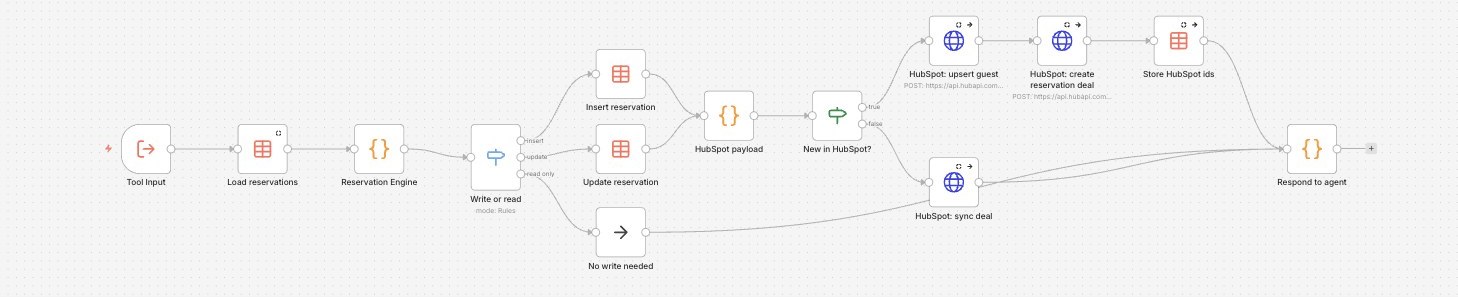
The reservation book and HubSpot are updated the same second — including later changes and cancellations made through the same code.
What the assistant actually does
It does not improvise. Availability, table assignment and the 90-minute seating rule are decided by the restaurant's rules, not by the language model — and a guard blocks any answer naming a booking, a price or a free slot the system did not confirm.
Reservations
- Check real availability
- Create, change, cancel, find
- Read the details back before saving
- Collect allergies and special requests
Questions
- Opening hours, menu, prices
- Parking, tram, accessibility
- Vegetarian, vegan, allergens
- Children, dogs, payment
Hand-over
- Groups larger than the online limit
- Anything it cannot confirm
- Goes to the team with a reference
- The guest always gets the phone number
Nobody replaces their reservation system
The assistant is a communication layer. Their own system stays the source of truth; n8n is the wiring in between. Swap the last box and the rest of the chain is unchanged.
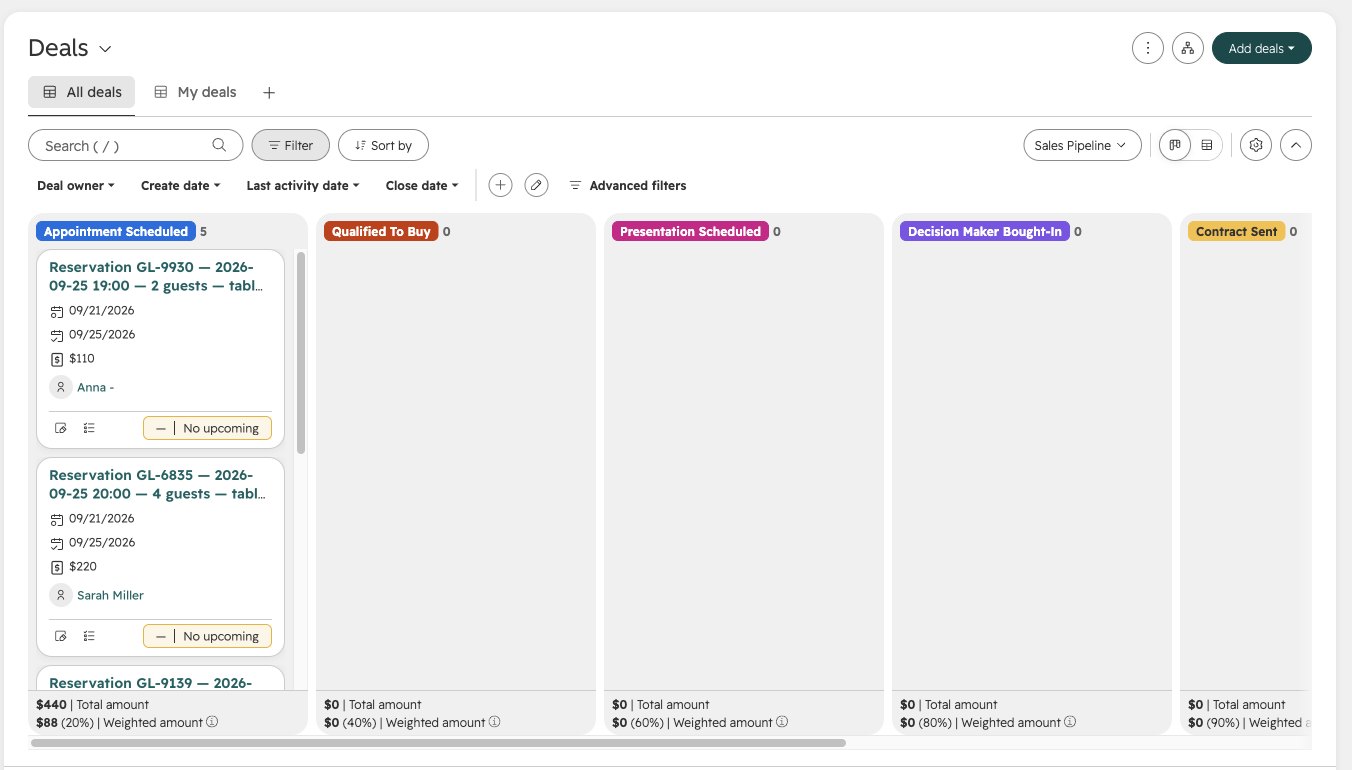
In the live demo every booking becomes a HubSpot contact with a linked deal: the seating as close date, party size, table number and expected spend. Move the booking and the deal moves; cancel it and the deal closes as lost.
See it working
The assistant below is live — the same one a guest reaches through the QR code. Book a table in it and the booking appears in the reservation book and in HubSpot while you are still on this page.
Try this
“A table for 4 on Friday at 20:00, one guest is vegan.” It checks the plan, picks a table, reads the details back and only then saves — with a code like GL-4821.
Then try to break it
Ask for a Monday, for 15:00, or for reservation GL-9999. It refuses instead of inventing — the rules, not the model, decide.
Then cancel it
“Cancel GL-4821.” The table frees up and the deal in HubSpot closes as lost, without anyone touching the CRM.

What is already built
Not a slide — a working restaurant you can book a table in right now.
What it costs to run
The assistant is paid per token, not per cover — a booking conversation costs less than a cent. Put in your own numbers.
Token calculator · gpt-5-mini
Your restaurant
Model and prices
No demo conversation measured yet — chat with the assistant and its real traffic lands here.
Where these numbers come from
They are counted by the workflow itself, not by this page. After every answer, the Output guard node in the n8n workflow AI Restaurant Assistant — De Gouden Lepel measures the conversation and returns the count together with the reply, which is what fills the fields above.
Four characters per token is the usual rule of thumb. The 1,550 is the assistant's own instructions measured character by character; the 900 covers the eight tool definitions the model receives on every call; the factor two is because a booking normally costs two model calls — one to consult the tools, one to answer. A running total per conversation is kept inside the workflow.
What it is not: the model provider's own meter. n8n does not hand the model's token count to that node, so this is an open estimate rather than an invoice — your provider bills the real number, and the prices above are the ones you type in, not a quote.
| Measured in your demo conversation | Tokens |
|---|---|
| Input (instructions, tools, the conversation) | — |
| Output (the assistant's answers) | — |
| Messages exchanged | — |
Estimate, not an invoice. The assistant counts four characters per token and adds the instructions and table rules the model re-reads on every call (about 2,450 tokens), over two model calls per message; the same method runs inside the n8n workflow and reports back with every answer. Your model provider bills the real number. Hosting and our fee sit on top of this.
What a new restaurant hands over
The assistant itself is not rebuilt per restaurant. Everything below is configuration — which is why the second restaurant is far quicker than the first.
Logo and colours, menu with prices, opening hours and last seating, table plan with zones, house rules for groups, allergies and cancellations.
Access to the reservation system or CRM. HubSpot is connected today; another system is one integration, not a rebuild.
The branded chat page, the AI instructions in their tone of voice, the rules engine, the guard layers and the CRM wiring.
A QR code on the tables, and the assistant answers from the first evening — with the restaurant's own name on it.
| Stage | What is built | What is reused |
|---|---|---|
| First restaurant | Branded chat page, their rules and menu, one CRM integration (HubSpot today) | — |
| Second restaurant | Their branding, their data, their CRM connection | The assistant, the rules engine, the guards, the QR flow |
| Next CRM | One integration in n8n | Everything the guest ever sees |
The minimum first version is deliberately small: a QR code, a branded chat without login, the six booking actions, the restaurant's own questions answered, and one CRM connected. Everything else on this page is built on top of that, not before it.
What comes next
The same assistant, reaching further. Green means it is already running in the demo you can open today; the rest is the road after the first restaurant is live.
Where guests reach it
Around the booking
For the owner
Beyond restaurants
Nothing here changes the promise: the guest keeps talking to the business they chose, and the business keeps the system it already pays for.